
Training

Elsabe Manning’s training courses are designed to improve your team’s communication, collaboration, productivity and customer service.
Disciplinary Hearings

We chair disciplinary hearings at very reasonable rates, and we provide our findings, in writing, within 24 hours.
Labour Consulting

We consult for companies and domestic employers alike. The Basic Conditions Of Employment Act and Labour Relations Act is applicable to all employers and employees in South Africa.
Subscribe to our mailing list:
AWARDS
- Success Factory won Business Acquisition’s Business Excellence Award 2020 as the ‘Best Business Coaching Consultancy in South Africa.’
- Success Factory won Excellence Business Acquisition’s Business Award 2019 as the ‘Best Business Coaching Consultancy – Gauteng’
- Elsabé was selected as one of The Most Inspirational Women of South Africa of 2012 as featured in Volume 2.
- Success Factory won The 2006 Mijima Award!
- Winner of the 2004 GreenPepper Enterprise Award which is awarded to South African companies that excelled in their industries, created economic growth or new job opportunities for the people of South Africa

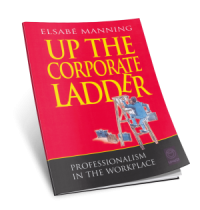
UP THE CORPORATE LADDER:
Professionalism In The Workplace
by Elsabe Manning
A practical guide to what true professionalism and competence entails, this book guides one through all manner of business interactions, from how to conduct oneself professionally while meeting with people from other cultures to the often overlooked rules of e-etiquette. Topics include: time management, networking, self-sabotage, travel etiquette and dressing for success.
TESTIMONIALS
The course presented by Elsabe to our front-line staff who deal with customer relations issues on a daily basis was filled with insight and assisted greatly in enhancing staff attitudes and behaviour, to be more professional in the workplace. Special mention has to be made of the personal and interactive style in which the course is done, which staff not only enjoyed, but also related to very well. Standard Bank would recommend the course to any Business who wished to achieve a higher understanding of what professionalism is about, and what it is not. Perfect grounding material for an improved image for staff who deal with customers every day.
I am an executive of a listed company in Johannesburg and must admit that I was nervous and felt very vulnerable at the prospect of running a workshop like this. I knew that there were a number of issues to resolve around my leadership and that there were team members who simply tolerated me and barely spoke to each other. We needed someone we could trust to help us rebuild the strong relationships we once had so that we could start trusting each other and move forward as a team again. Elsabé is amazing. She created a safe environment for everyone to speak without fear of consequences. She helped us to rebuild the team through open communication and real collaboration so that we are once again totally commitment to each other and the organisation. We left the workshop having set team goals and objectives which are aligned to the organisation’s goals and objectives. Thank you Elsabé. We couldn’t have done it without you.